
Top 5 Beginner-Friendly Instruments
1. Ukulele
Why it's great: Nylon strings are soft on uncalloused adult fingers, and the fretboard is small enough that reach is rarely an issue. You only need to learn 3 to 4 basic chord shapes to play hundreds of popular songs.
Best for: Anyone who wants to play and sing along quickly with minimal setup or investment.
2. Digital Keyboard / Piano
Why it's great: The layout is completely visual—notes progress logically from left to right. Unlike brass or woodwinds, pressing a key produces a perfect, clear pitch every single time without requiring complex breathing or mouth technique. Modern keyboards also allow headphone practice, ideal for apartments or late-night playing.
Best for: Visual learners, fans of classical or pop music, and those who want a strong foundation in music theory.
3. Kalimba (Thumb Piano)
Why it's great: Most kalimbas are pre-tuned to a single scale (usually C Major), meaning there are no "wrong" notes. Plucking the metal tines with your thumbs creates a soothing, music-box tone almost instantly.
Best for: Stress relief, casual playing while relaxing on the couch, or people intimidated by reading traditional notation.
4. Acoustic Guitar (Nylon String / Classical)
Why it's great: While steel-string acoustic guitars can hurt beginner fingers initially, nylon-string classical guitars offer a softer touch while maintaining the full range and versatility of guitar music.
Best for: Folk, rock, and pop enthusiasts willing to push through the first 2-3 weeks of building finger muscle memory.
5. Bass Guitar
Why it's great: Bass typically plays single-note lines rather than complex multi-finger chords. It lets you join a band or ensemble very quickly because fundamental basslines are easy to grasp, even though mastering groove takes time.
Best for: Team players who love rhythm, low frequencies, and playing with other musicians.
How to Choose the Right Instrument for You
To narrow it down, evaluate your choice across four practical categories:
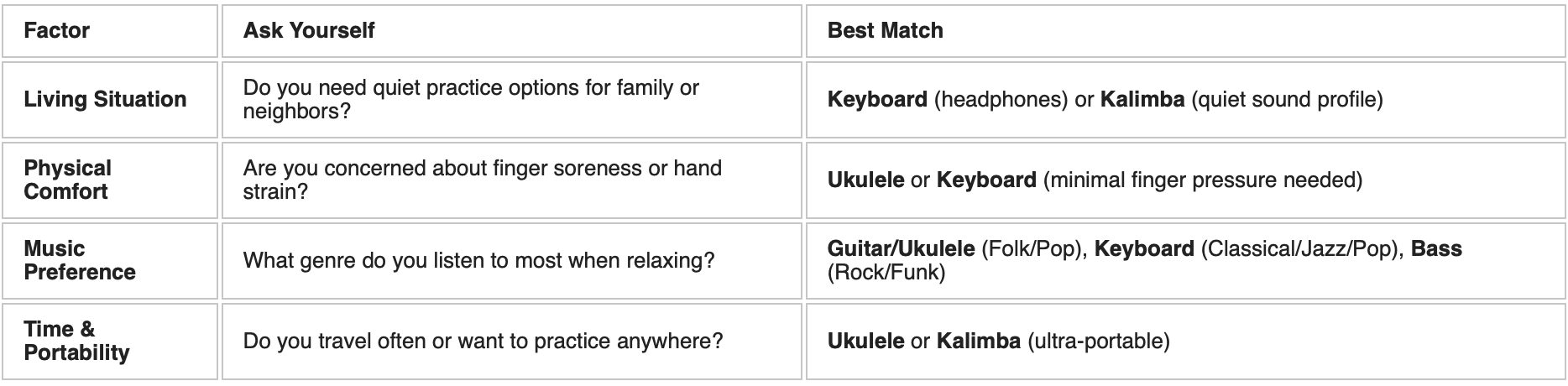
The Ultimate Test: Listen to What Excites You
Technical difficulty matters less than motivation. If you love the sound of the piano, don't force yourself to play ukulele just because it seems easier. The instrument that excites your ears will be the one that keeps you coming back for 15 minutes of practice every day.
